


Written by: Patricia O’Brien
As you pick yet another zucchini from the vine sagging on the ground or pluck another tomato that you hope will ripen to add to your batch for winter sauce, you are likely not thinking about next summer’s garden. Yet some of us will be picking up our fall order of low-water perennials provided by the Garden in a Box team at Resource Central in mid-September. I will be quickly filling in some of the blank or “did not work” areas of my backyard garden. Lest you think that late summer planting is ill-advised as we head into the chill of winter, note that the ground remains warm for the establishment of root systems until first frost (estimated by the National Weather Service as October 8th).
As I look at my glorious blooming Rudbeckia in my backyard, I realize that the one constant of my plant life in four different locations in four different states are perennials. I love the variety of their shapes, sizes, colors, their recurrent nature, and their dependability in almost any landscape. One of my newish gardening goals is to plan my garden for sequential blooming so I’m often looking for new varieties. Recently, I had the opportunity to hear Alison O’Connor, Extension Professor of Horticulture for CSU Extension in Larimer County giving a presentation sponsored by Resource Central about perennials and their late summer and fall care. Before discussing specific species, Alison emphasized some important points about the growth and care of perennials including:
- Grouping plants with similar water needs together
- Mixing perennials with shrubs, under trees, with bulbs, and ground covers to provide more interest even when plants are not in bloom
- Considering how plants will grow and spread, and
- Seeing the benefit of contrasting foliage and blooms. For example, “lime rickey” coral bells adjacent to “black pearl” coral bells. Whether or not we get to that sort of fine tuning depends on the plants we choose (and how far we are willing to go for a broader choice outside of the Pueblo market). If you are not sure which plants go together, consider the drive suggested elsewhere in this issue to observe what you prefer. Alison also suggested visiting demonstration or botanic gardens to get ideas. Best of all, the plant select webpage, https://plantselect.org/ includes many free and accessible suggested designs.
Recommended Perennials for Fall Planting
If you have the energy to do some fill-in planting, once you’ve found your choices, Alison suggests roughing up the root system by using your fingers or cutting apart the roots with a knife, planting them so that the top of the root ball is level with your soil, and then pressing firmly around the plant to eliminate air pockets that may cause it to dry out and limit nutrient and water flow. As is true in any season, water deeply and consistently. And to assist in our dry landscape, even in the winter, provide mulch (either wood or squeegee) to retain moisture for the new plants. Overwintering care of fall-planted perennials includes adding an insulating layer of mulch once temperatures are consistently cold and providing regular water as long as possible until the ground freezes (usually in November). Like your trees, be sure to water occasionally on warm winter days.
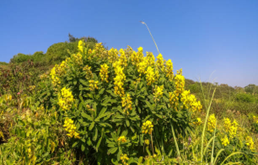
After general discussion of perennial care including division, Alison shared some of her favorites from the Plant Select archive. These included Thermopsis lupinoides “Golden Candles”, a cold hardy plant that is a very early bloomer with dazzling yellow flowers that is great for early pollinators.
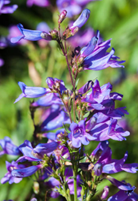
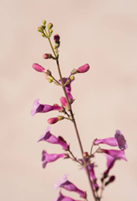
She recommends any penstemon, but a Plant Select beauty to know about is, ‘Carolyn’s Hope’, bred by the grower in the name of his wife diagnosed with a form of breast cancer or my favorite, ‘Pike’s Peak Purple.’ Easy care penstemons are known for their long blooming enjoyment.
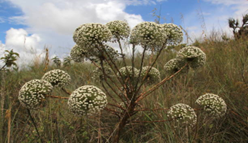
Finally, one of the most interesting and new-to-me varieties that Alison introduced was the ‘Moon Carrot’ Seseli gummiferum. This plant was recommended to Plant Select after it was field tested by the Denver Botanic Garden. It produces initially silvery-blue lacy foliage and in later development, large pink umbels.
I hope this has inspired you to expand your gardening delight.