


Written by: Di Graski
I recently listened to a Science Friday episode from 2024 discussing the “Green Glacier” spreading through our eastern neighbors. Science Friday Host Ira Flatow introduces the episode by saying, “I always thought no tree was a bad tree.” Here in the City of Pueblo, trees are precious: they offer shade, some offset of our urban “heat sink,” and provide habitat and food for birds, insects, and mammals.
But the Master Gardener mantra is “Right Plant, Right Place,” and some places don’t benefit from trees – indeed, some places risk ruin from the Green Glacier of invasive trees. In South Dakota, Nebraska, Kansas, and Oklahoma, invasive “woodies” are outcompeting native grasses and forbs (flowering plants) of the short grass prairie, the tall grass prairie, and everything in between.
The proliferation of non-native trees in the Great Plains started with events like the first Arbor Day in America in 1872: European settlers planted one million trees across Nebraska . . . in one day. In South Dakota, sod-hut settlers hoped that introducing tree species like Red Cedar would create fast-growing, hearty windbreaks, and help keep their topsoil in their plowed fields.
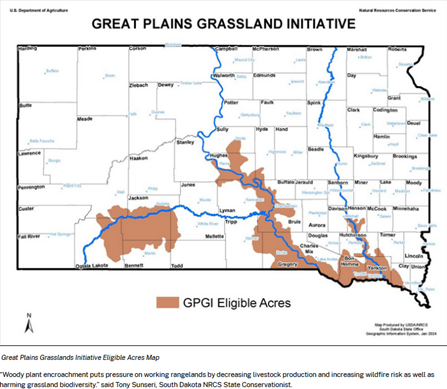
Now, 150 years later, we understand the unintended consequences. The United States Department of Agriculture’s Natural Resources Conservation Service (NRCS) is offering grants through its Great Plains Grasslands Initiative to combat invasive woodies and slow the Green Glacier. One example is this map of South Dakota’s eligible areas:
Expert nonprofits like The Nature Conservancy (TNC) and state university Extension Offices are pitching in, too. If you have ever driven through Eastern Kansas on Highway 50, you have seen signage for prairie preserves in the Flint Hills. A similar site is a TNC project in the Sandhills of Nebraska:

Pueblo County CSU Extension’s Agriculture & Natural Resources Specialist Beth Hayes helped me understand that our neighbors’ Green Glacier is happening in Southeast Colorado, too, but our hues include Silver Glacier and Pale Pink Glacier: Russian Olives and Tamarisk (a/k/a Saltcedar). Elaeagnus angustifolia and Tamarix spp. Sigh. Personally, I would include Siberian Elm (Ulmus pumila) on our invasive woody list, also.
Just like our neighbor states, Pueblo County’s invasive woodies were introduced – not native. Tamarisk was imported to many western states as the cure-all for eroding creek banks. Siberian Elm trees were the suburban streetscape monoculture of the 1950s. Russian Olive trees came west with European settlers more than 100 years ago, because they are pretty, in their way, and tough.
So, what does it mean to be an “invasive woody”? Invasive trees outcompete native plants. For our eastern neighbors, lush pasture grasses that feed livestock are lost to the Green Glacier. For Puebloans, native trees, forbs, and grasses simply cannot outproduce elm trees, Russian Olives, and Tamarisk. You can see it with your own eyes: no other plant grows under a Russian Olive or amidst a Tamarisk thicket. Tamarisk control all the resources in their territory (water, sunshine, and soil).
And these invasive trees propagate wildly, like rabbits. Siberian Elm and Tamarisk are amazingly prolific. Think back to late spring, early summer, when the elm tree seeds were ripe and falling from the sky like snow, like confetti: billions of little white seed packets everywhere. One mature Tamarisk can produce 600,000 seeds every year.
But that is not all. Invasive woodies also pose heightened wildfire risks. For our eastern sister states, once a piece of the Green Glacier ignites, the wildfire will burn hotter, and higher, than any grassfire, doing far more damage across many more square miles. The same is true in Pueblo, and a cruel irony is that a wildfire will not kill a Tamarisk.
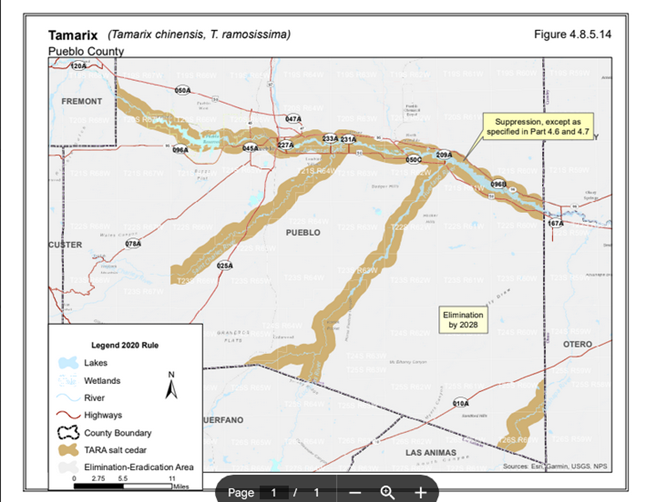
For all these reasons, Russian Olives and Tamarisk are on the Colorado Department of Agriculture’s Noxious Weed List B. (New Mexico includes Siberian Elm on its Noxious Weed List.) Each Colorado county submits data and a management plan for combatting List B noxious weeds, and you can review Pueblo County’s noxious plant statistics here: https://docs.google.com/spreadsheets/d/1fHXmYI_VY0MGNqe0ZZzJ8NwXON-Lr3Rs8i_KvBY0Vug/edit?gid=1933819886#gid=1933819886 . For example, Pueblo County’s Tamarisk management goal is to eliminate in some areas and suppress – at the very least, control the Pink Glacier’s spread – in other areas:
So what can we gardeners do to help slow our Green/Silver/Pink Glacier?
- Eliminate these trees from our own properties. And keep at it until they are good and dead: chain-sawing a Russian Olive at soil level will not kill the plant. Both Siberian Elms and Russian Olives spring back from their stumps with fresh vigor. Walk along the Arkansas River trail on the north bank between Waterworks Park and the confluence with Wild Horse Creek: significant mitigation was done last autumn and, one year later, happy sprigs of Russian Olive are abundant.
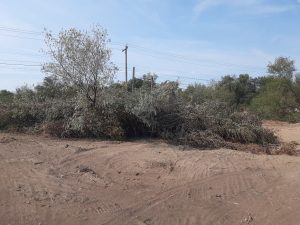
It’s daunting, but every battle helps stop the spread. Here’s a photo of recent elm and Russian Olive mitigation efforts along Wild Horse Creek at West 18th Street:
- Replace Bad Neighbors with Nice Neighbors. Plant native trees, if possible, and definitely trees that CSU Extension recommends (the Front Range Recommended Trees List was just updated last year).
Trees offer us many, many benefits, like shade and cooling in the summer, visual delights, and shelter and sustenance for birds, insects, and other wildlife. But we need trees that act like Nice Neighbors: no bossing others around or driving them out altogether.
Want to learn more?
Science Friday, “Trees and Shrubs Are Burying Prairies Of The Great Plains,” https://www.sciencefriday.com/segments/great-plains-trees-green-glacier/ (Originally aired 5/10/2024).
CSU Extension, “Selecting Large Deciduous Trees,” https://extension.colostate.edu/resource/selecting-large-deciduous-trees/ (Published 2000; Reviewed 2025). Table 1 includes many elm (Ulmus) varieties that are resistant to Dutch Elm disease, a fungal infection that maims and slowly kills many of Pueblo County’s legacy elms.
Nevada Extension, “Identification and Management of Russian Olive,” https://extension.unr.edu/publication.aspx?PubID=3949 .
University of Arizona Cooperative Extension, Coconino County, “A Northern Arizona Homeowner’s Guide To Identifying and Managing Tamarisk,” https://azinvasiveplants.arizona.edu/sites/azinvasiveplants.arizona.edu/files/2024-01/Tamarisk.pdf .
CSU Extension’s Front Range Tree Recommendation List: https://cmg.extension.colostate.edu/wp-content/uploads/sites/59/2024/04/2024-Front-Range-Tree-List.pdf (Updated 2024).