


By Patricia O’Brien, CMG, 2018
Winter has arrived with multiple gray days rolling more quickly into the dark each passing day and less memory of the garden smells in summer’s heat. With a little effort and planning, you can score plants that provide a variety of hues and textures that will bring joy in your landscape.
Let me begin by defining what is meant by “winter interest,” as it can mean a variety of observable plant characteristics that provide visual appeal or ecological benefit in a dormant or snow-covered landscape during the coldest months. It is not a scientific classification but rather a horticultural term to describe (and promote) plants that stand out when others have lost their natural beauty.
Characteristics to look for include persistent structure and form in either deciduous or evergreen plants that have a dramatic branching habit. Ornamental grasses also fall into this category with their tall, upright stems and feathery seed heads that blow in the wind. Plants that maintain their leaves or needles year-round such as various conifers, hollies, and ferns provide consistent color and a backdrop to the starker winter landscape. Colorful stems and bark, such as red- or yellow-twig dogwood, offer striking color against a white or brown background. In my search, and by asking other Master Gardeners, I have found several options that are good in our climate to consider for next winter’s garden spark.
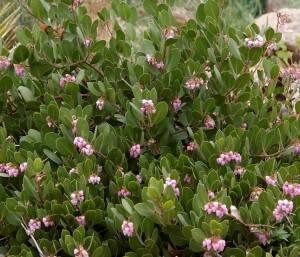
‘Panchito’ Manzanita (Arctostaphylos ‘Panchito’)
Habit: This broadleaf evergreen shrub is highly valued in Colorado landscapes for its striking, smooth, reddish-brown bark that peels away to reveal an elegant, contorted branching pattern. It maintains its structure year-round, is extremely hardy and drought tolerant, and produces pink flowers and then small, red berries on established plants. Best planted on a slope with good drainage and prefers late afternoon shade.
Image Source: CO Plant Select listing
++++++
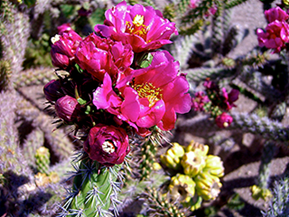 Tree Cholla (pronounced “CHOY-ya”) (Cylindropuntia imbricata)
Habit: This is a native cactus with a distinctly sculptural, almost skeletal, woody-stemmed structure. Its rigid, often symmetrical branching creates a bold, architectural statement in a xeriscape garden. Native to the Lake Pueblo State Park area, it is extremely drought-tolerant and well-adapted to the local environment. Slow grower but eventually gets shrubby or tree-shaped. Woody stems appear braided and the magenta flowers and yellow fruit are showy. Dead stems have interesting “skeletons” once the soft tissue has decomposed. Full sun, dry soil. Caution: has sharp spines.
Image Source: Ladybird Johnson Wildflower Center
++++++
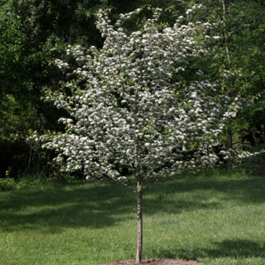 “Winter King” Hawthorn (Crataegus viridis ‘Winter King’)
Habit: This small (25 – 35 feet tall), deciduous tree develops a lovely, horizontal branching pattern as it matures. While the branching is subtle in summer, it becomes a beautiful focal point in winter, with its attractive silvery-gray bark, and especially when covered with persistent red berries attracting birds. It is a hardy, full-sun, drought-tolerant tree that adapts well to a wide range of soil conditions but requires good drainage.
Image Source: Arbor Day Foundation
+++++
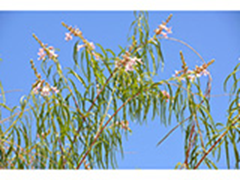 Desert Willow (Chilopsis linearis)
Habit: The desert willow has a naturally airy, graceful, and often multi-trunked habit with slender branches. It provides a delicate, informal structure, often used as a large shrub or small tree. It is highly drought-tolerant, is listed on the City of Pueblo’s recommended plants list (https://www.pueblo.us/DocumentCenter/View/517/Recommended-Plant-List ), thrives in the local climate, but is susceptible to overwatering. Showy and fragrant blooms are attractive to hummingbirds and nectar-sipping insects. Attractive foliage in the winter.
Image Source: Ladybird Johnson Wildflower Center
++++++
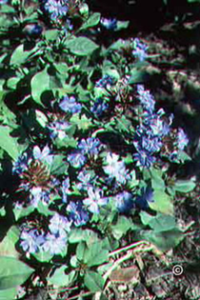 Hardy plumbago or leadwort (Ceratostigma plumbaginoides)
Habit: A final plant to introduce you to is hardy plumbago or leadwort that boasts a profuse display of blue blooms in early fall followed by striking burgundy foliage that lasts well into the fall even after frost. Plant Talk Colorado (https://planttalk.colostate.edu/ ) says that this low-growing ground cover is easy to grow in average soil, thrives in partial shade, and requires only light watering once established.
Image Source: Plant Talk Colorado, https://planttalk.colostate.edu/topics/annuals-perennials/1048-leadwort/
Enjoy investigating these showy options and enjoy your plants’ display regardless of the season!