


Written by: Di Graski
Several of your fellow Pueblo gardeners experimented with a new-to-them planting medium this year: coconut coir. We want to let you know what we learned so that you can make an informed decision about whether you would like to try it too. First, though, a bit of background about coir.
What is Coir?
Coir is coconut husk, a byproduct of processing the edible meat and oil of coconut. When comparing coir to peat moss, upcycling the coconut byproduct into a planting medium prevents waste and creates an excellent product for gardeners from a renewable source. In contrast, peat moss is a finite resource – decomposed, ancient sphagnum moss – and its collection wreaks havoc on the environment.
Coir is pH-neutral. In contrast, peat moss is acidic; for this reason, plants started in a peat-based medium can be ill-adapted to Pueblo County’s alkaline soil.
Dry peat moss is hydrophobic, meaning it is challenging to get the material to accept water. In contrast, coir has excellent moisture-absorption and water-retention capabilities.
An added bonus: coir’s cation exchange capacity is higher than peat moss’s. Cation (pronounced cat-ion) exchange capacity is a measurement of soil’s potential to supply plants with nutrients like calcium and nitrogen in a format that plants can actually use.
What Coir Products Are Available?
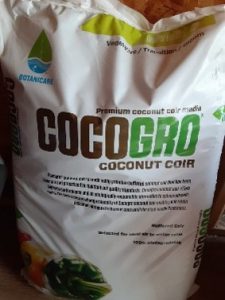
Coco Grow is the trade name for a business that manufactures coir. ReadyGro Aeration is the name of a product that combines coir and perlite, and CocoGro is the name of a product that is pure coir.
How Do You Use Coir?
Coir first captured the attention of hydroponic gardeners as a soil-less growing medium. Now gardeners are finding the value of coir as a seed-starting medium, as a potting mix (especially for succulents), as a soil amendment, and as a mulch. Coir is quite durable and can be reused. Coir naturally contains potassium (K), so gardeners might need to adjust their fertilizing regimens.
Darla’s Coir Story
Pueblo Master Gardener Darla Carlock used an 80-20 mix of coir and perlite as a soil amendment for her vegetable garden this past spring. Her veggies and herbs grow in a raised bed that is filled with topsoil. Darla’s hope for the coir amendment to her raised-bed soil was two-fold: (1) improve water absorption and retention, especially when we experience “fast and furious” rainstorms, and (2) increase pore size to improve aeration and water penetration.
In Pueblo, our clay soil can easily become compacted, and plant roots do not like living in a brick. Darla was pleased with coir as a soil amendment because it added organic material to her raised-bed soil, thereby improving its ability to accept water and provide oxygen to her vegetable and herb roots.
Di’s Coir Story
All my gardening life, I have purchased big bags of potting mix in the spring for my patio containers. I had heard some news of the environmental damage caused by the harvest of peat moss, which is the main ingredient in potting mix, and it concerned me, but honestly, I did not know there was an alternative. Then Grow Generation in Pueblo West donated several pallets of coir products to the Supporters of Horticultural Education (SHED) in April, and I vowed to try it.
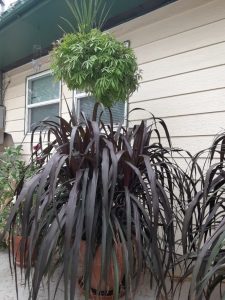
In my patio containers this year, I used an 80-20 mix of coir and perlite, and I am really impressed with the results. Here is a photo of a hanging basket with “spikes” and sweet-potato vine, above a large clay pot with Pennisetum hybrid (“Majestic” Napier Grass). These foliage plants were seedlings in small (like four inch) pots that I transplanted into their containers at the end of May.
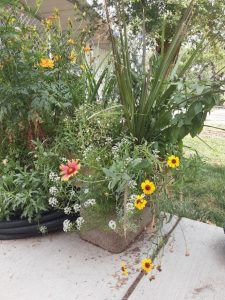
In a different patio container – a fairly shallow (6 inches) trough – I sprinkled a mélange of wildflower and herb seeds among transplanted “spikes,” and they have performed beautifully.
Based on my experience this year with coir-perlite in patio containers, I can share these “lessons learned”:
- My patio plants were quite happy with a half-strength dose of 20-20-20 water-soluble fertilizer, which I added nearly every (but not every) time I watered. Coir is not “dirt,” so plants in a majority-coir mix must be provided with regular fertilizer.
- Pueblo’s wind knocked over my patio pots regularly, perhaps because we have crazy wind, but also because coir and perlite are lightweight. Next year I will be smarter about adding big, heavy rocks to the bottom of my patio containers with the hope that they will serve as anchors.
Dave and Carol’s Coir Plans for 2026
Master Gardeners David and Carol Sams are planning to create this custom seed-starting mix for their 2026 starts:
- One third coco coir
- One third coco coir-perlite mix
- One third potting mix with slow-release fertilizer (potting mix is mostly shredded/ground material from trees)
I look forward to learning from Dave and Carol next spring how their custom coir mix performed – and I predict it will be a glowing report.
Have you used coir? Your Master Gardeners would love to hear more about your experiences! Please share at pueblomastergardeners@gmail.com . Thank you!
Want To Learn More?
Washington State University, Kittitas County Extension, “Coconut Coir vs. Peat Moss,” https://s3.wp.wsu.edu/uploads/sites/2080/2018/03/coconut-coir.pdf (March 2018).
Ohio State University Extension, “Calculating Cation Exchange Capacity, Base Saturation, and Calcium Saturation,” https://ohioline.osu.edu/factsheet/anr-81 (8/22/2019).
Oregon State University, “Harvesting Peat Moss Contributes to Climate Change, Oregon State Scientist Says,” https://news.oregonstate.edu/news/harvesting-peat-moss-contributes-climate-change-oregon-state-scientist-says (12/9/2022).